
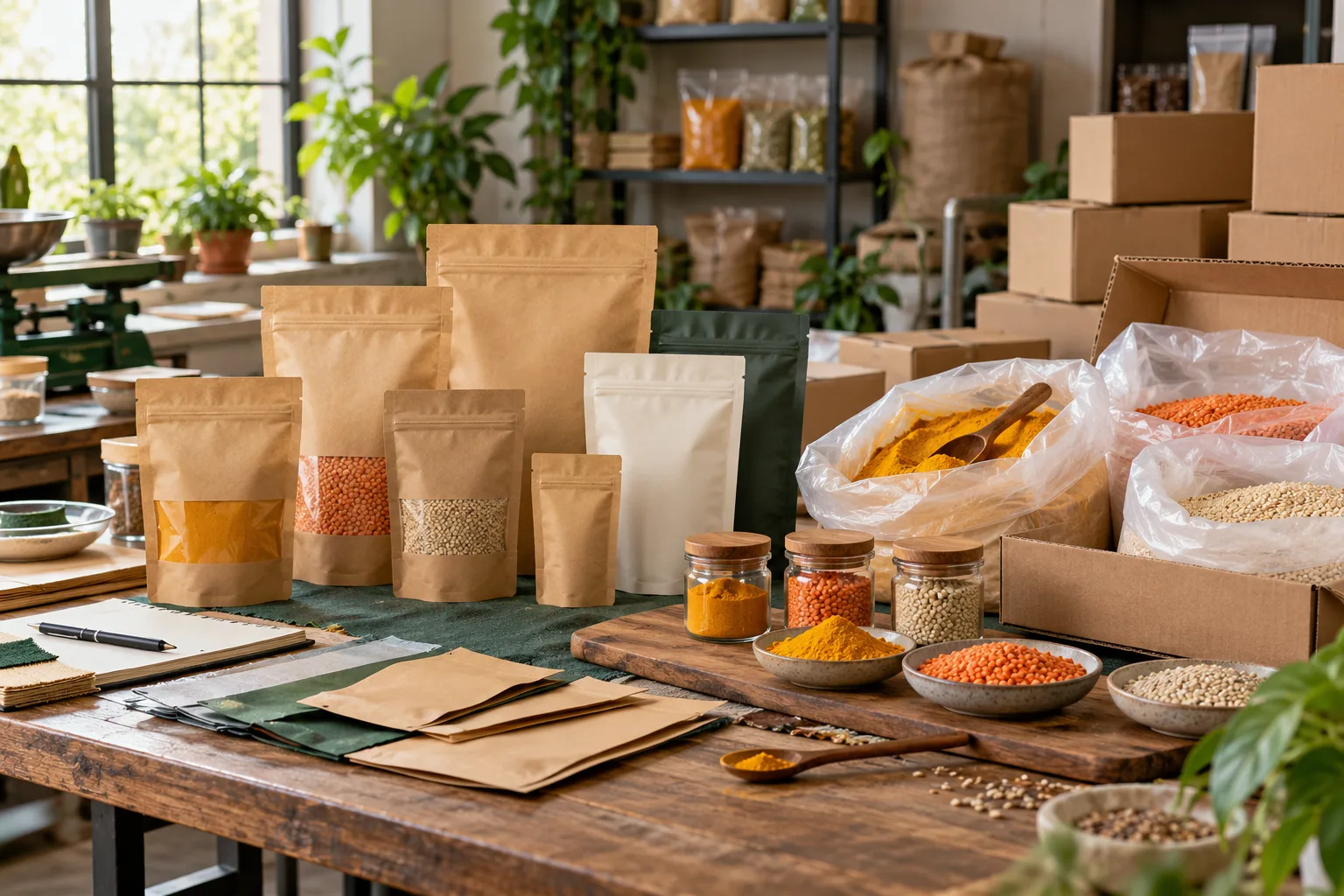
Growsian Agro coordinates bulk export packaging for importers, manufacturers, distributors, wholesalers and private-label brands buying certified organic products from India. The objective is not just to move a packed product. It is to protect product integrity, align contractual responsibility and prevent avoidable delays or damage.
Request an Export Quote | Send an enquiry
Packaging topics
Bulk formats are selected against the product, net weight, handling method and shipment route. Review the relevant options for private-label packaging, food-grade liners and bags, drums, cartons and rigid containers, retail pouches and jars, moisture and oxygen barriers, export labels and artwork, palletisation and container stuffing and ISPM 15 wood packaging.
Why this matters
Packaging and logistics decisions affect moisture, contamination, breakage, shelf life, freight utilisation, customs clearance and buyer handling. The right solution depends on the actual product, pack size, order quantity, route, destination and Incoterm.
A generic statement such as “export packing included” is not a usable specification. The quotation should identify the packaging components, quantity basis, pallet method, shipment term and document responsibility.
Requirement inputs
| Input | Information required |
|---|---|
| Product | Identity, form, density, odour, oil content and sensitivity |
| Quantity | Net quantity, number of packs, pallets and shipment frequency |
| Primary pack | Material, liner, closure, barrier and food-contact requirement |
| Secondary pack | Bag, carton, drum, jar, pouch or other shipping unit |
| Palletisation | Pallet type, pattern, height, stretch wrap and corner protection |
| Destination | Country, port, importer, warehouse and local handling constraints |
| Trade term | Named Incoterms rule, named place or port and version |
| Documents | Invoice, packing list, transport record, certificates and buyer formats |
| Labelling | Product, lot, dates, net weight, origin, organic and handling marks |
Packaging hierarchy
Product-contact layer
The product-contact material should be suitable for the ingredient and intended market. It must protect against relevant transfer, contamination and leakage risks.
Secondary package
The outer bag, carton, drum or container supports handling, stacking and identification. Strength must suit pack weight and distribution conditions.
Unit-load protection
Pallets, slip sheets, stretch wrap, straps, corner boards and top sheets stabilise the shipment. They should not crush the product or block required marks.
Freight container
The container is the final transport environment, not a substitute for proper packaging. It should be clean, dry, odour-free, structurally sound and suitable for the cargo.
Product-specific considerations
- Powders need leakage control, liner integrity and moisture protection.
- Whole grains, pulses and seeds need infestation, puncture and condensation controls.
- Oils require closure integrity, headspace and leak-containment planning.
- Botanicals and spices may transfer or absorb odours.
- Retail packs require artwork, barcode and destination-label approval.
- Fragile jars or rigid packs require dividers, compression review and drop protection.
Organic integrity during handling
Organic cargo should remain identified and protected from substitution, mixing and prohibited contamination. Controls may include:
- verified lot labels;
- clean and released packing lines;
- segregation from conventional and incompatible goods;
- documented packaging issuance and reconciliation;
- controlled rework and damaged-pack handling;
- seal management;
- container inspection records;
- final quantity reconciliation.
Artwork and shipping marks
Bulk and retail labels should be approved before printing. The exact requirements depend on the buyer and destination, but the review normally covers:
- product name and form;
- organic claim and certifier reference;
- lot or batch number;
- packing and best-before dates where applicable;
- net weight and number of units;
- storage conditions;
- country of origin;
- manufacturer, packer, exporter and importer details as required;
- allergen and ingredient information;
- handling, pallet and shipping marks.
Information must remain consistent across labels, invoice, packing list, certificates and transport records.
Shipment planning workflow
- Define product, quantity, destination and trade term.
- Approve product and packaging specifications.
- Confirm certified source, processor and packing activity.
- Reserve packaging material and production capacity.
- Review artwork and shipping marks.
- Confirm testing and document requirements.
- Book freight and capture carrier cut-offs.
- Inspect product, packs, pallets and container.
- Stuff, count, photograph and seal the load.
- Issue final documents and track delivery milestones.
Commercial responsibilities
The sales contract should clearly allocate:
- inland movement to the export point;
- export customs clearance;
- terminal handling;
- main carriage;
- insurance where applicable;
- destination handling and customs;
- duty and tax;
- unloading and inland delivery;
- inspection, demurrage and detention exposure;
- claims notice and evidence.
Use the full Incoterms rule with the named place or port and version, for example, [selected rule] [named place], Incoterms 2020. The correct rule should be selected with trade and legal advisers for the actual movement.
Documents to coordinate
The shipment file may include:
- commercial invoice;
- packing list;
- shipping bill and customs records;
- bill of lading or airway bill;
- certificate of origin;
- organic shipment certificate;
- COA or laboratory reports;
- phytosanitary or fumigation evidence where required;
- insurance certificate where contracted;
- pallet or ISPM 15 evidence where applicable;
- inspection and container-stuffing records.
Not every document applies to every product. The final checklist should be agreed with the importer and broker before dispatch.
Common failure points
- Packaging is selected before product density and route are known.
- Artwork is printed before importer approval.
- The quotation does not define net and gross weights.
- The named Incoterm place is missing.
- LCL cargo is exposed to incompatible odours or moisture.
- Pallets are unacceptable at destination.
- Container condition is not recorded before loading.
- Desiccants are used without addressing wet cargo or packaging.
- Document data does not match labels and physical counts.
- Destination charges and free-time terms are not understood.
Information needed for quotation
Product and form:
Quantity:
Bulk or retail pack:
Primary packaging requirement:
Units per carton or bag:
Pallet requirement:
Destination country and port:
Preferred Incoterm:
LCL or FCL:
Private label: Yes / No
Artwork status:
Required documents:
Target shipment date:
Frequently asked questions
Can you customise bulk packaging?
Yes, subject to material availability, food-contact suitability, certified packing scope, MOQ and lead time.
Can several products share one shipment?
Yes, if they are compatible for certification, odour, allergens, moisture, stacking, release timing and documentation.
Do you arrange freight?
We can coordinate freight quotations under the agreed trade term. Carrier availability, rate validity and destination charges remain shipment-specific.
Can you provide CIF pricing?
Yes, after the destination port, cargo details, shipment timing and insurance requirement are defined.
Who approves labels?
The buyer and importer should approve destination-market labels. The certification body may also need to approve organic claims or logo use.
Are wooden pallets always allowed?
Requirements vary. Covered raw-wood packaging frequently needs compliant ISPM 15 treatment and marking. Buyer and destination rules must be confirmed.