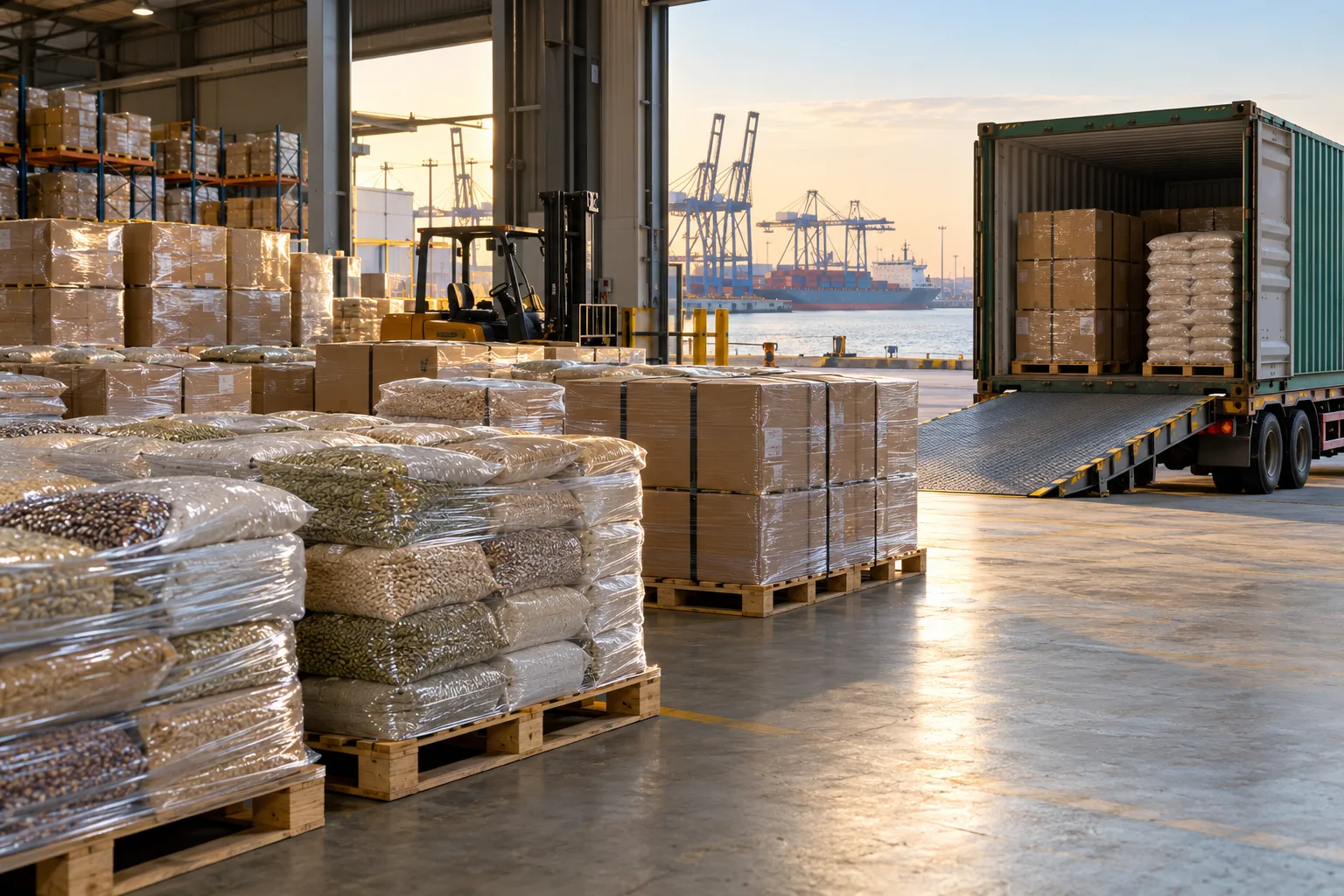
Growsian Agro coordinates FOB supply for importers, manufacturers, distributors, wholesalers and private-label brands buying certified organic products from India. The objective is not just to move a packed product. It is to protect product integrity, align contractual responsibility and prevent avoidable delays or damage.
Request an Export Quote | Send an enquiry
FOB supply explained
FOB (Free On Board) is an Incoterms rule for sea and inland-waterway transport. Under FOB, the seller delivers the goods on board the vessel at the named port of shipment; from that point, risk and the main-carriage cost pass to the buyer. It is widely used where the buyer wants to control the ocean freight and onward movement.
The FOB boundary and risk transfer
The critical point in FOB is loading on board at the named port: the seller is responsible up to that point, and the buyer carries the risk and cost of the sea freight, insurance and destination handling thereafter. Clarity about that boundary avoids disputes over who bears a loss.
Cost split
Under FOB the seller bears the costs to get the goods loaded on board — inland movement to the port, export clearance and terminal handling to loading. The buyer bears the ocean freight, insurance (if taken) and destination costs. This differs from CFR and CIF, where the seller pays the main-carriage freight.
The named-port rule
An FOB quotation must state the named port of shipment and the Incoterms version, for example “FOB [named port], Incoterms 2020”. An FOB price without a named port is incomplete. Select the rule with trade and legal advisers for the actual movement.