
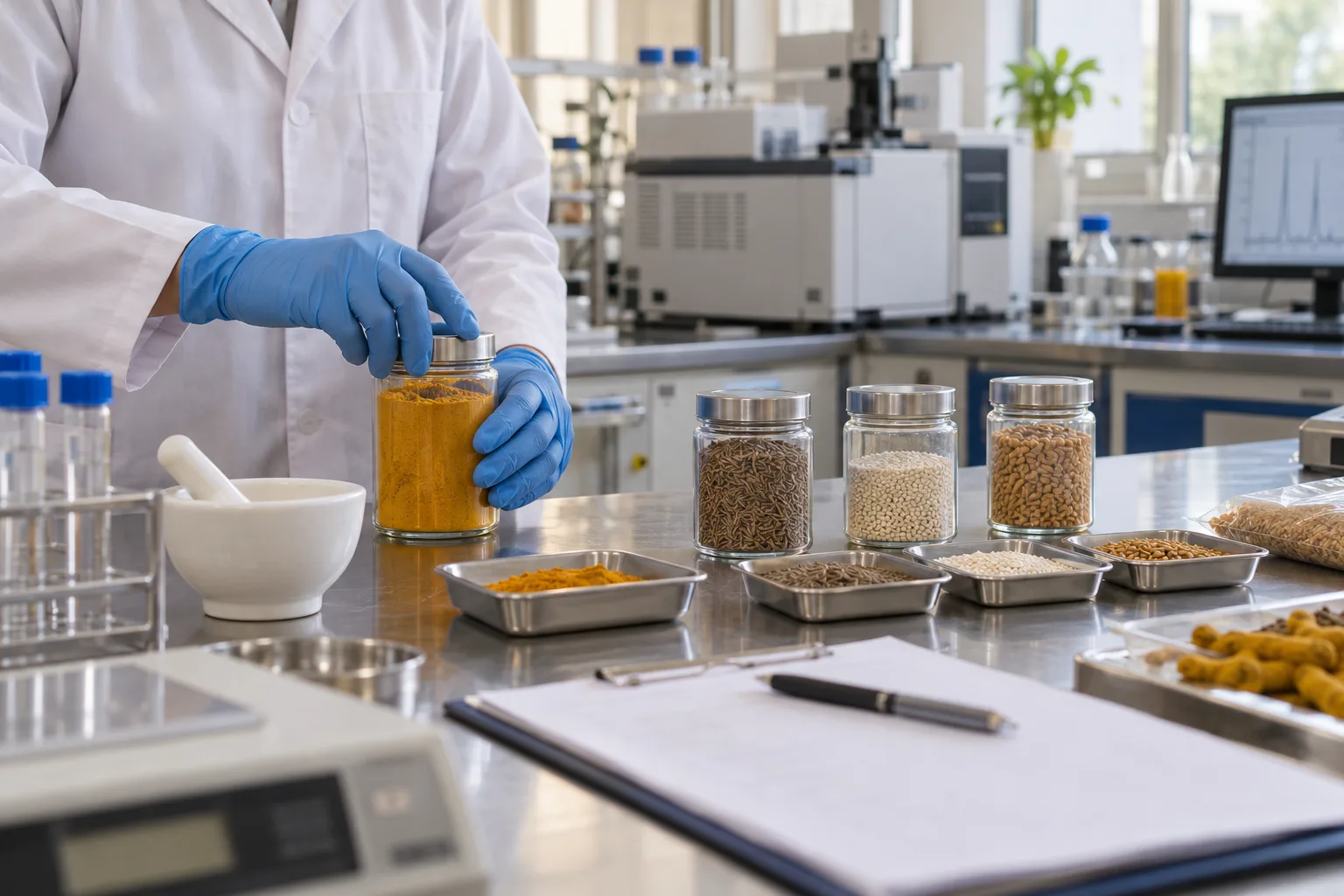
Growsian Agro coordinates heavy metals testing within a documented export supply programme. For each order, the relevant product, operator, lot, evidence and destination requirements are aligned before dispatch.
Certification and quality evidence must match the exact product, operator, activity, lot, shipment and destination. A logo or certificate shown out of context is not enough to prove eligibility for every order.
Send an enquiry | Submit a Product Requirement
Why heavy metals matter
Heavy metals such as arsenic, lead, cadmium and mercury can accumulate in crops from soil, water and the environment, independent of farming method. Organic certification does not control heavy-metal content, so testing is used where the commodity and destination make it relevant.
The metals of concern
The metals usually of interest are arsenic (As), lead (Pb), cadmium (Cd) and mercury (Hg). Which of these matter most depends on the commodity: rice, for example, can accumulate arsenic and cadmium, and roots and botanicals can carry higher metal loads because they draw from the soil directly.
Higher-risk commodities
Root crops, rhizomes and botanical materials tend to carry more soil-derived metal than aerial parts, so products such as certain powders, roots and botanicals are more likely to warrant heavy-metal testing. Match the test to the commodity’s risk rather than testing indiscriminately.
Methods and market-specific limits
Heavy metals are typically measured by instrumental methods, such as ICP-based techniques, on a defined sample. Limits differ by market, by commodity and by intended use, and they change over time. We do not publish fixed numeric limits because the buyer and destination market define the applicable limits, the metals to test and the method. Confirm current limits with the destination authority or the buyer’s specification. See the testing overview.